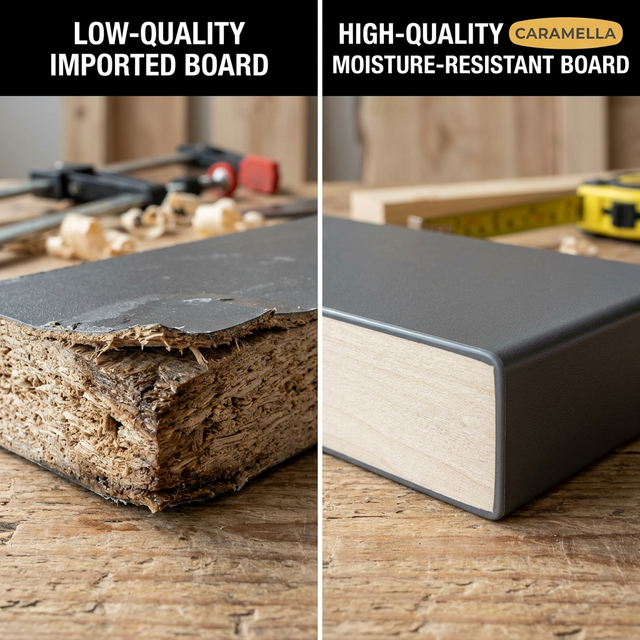
1. The Board Density Trap
Most imported flat-pack kitchens from massive China-based franchises utilize low-density particle boards to save on shipping weight. While these look perfect in a showroom, they lack the internal bonding strength to withstand the 80-90% humidity in areas like Tungku or Rimba without eventually sagging or warping.
2. Edge-Banding Failure
The number one reason for kitchen failure in Brunei isn't the wood—it's the glue. Sea-freighted cabinets spend 4-6 weeks in a shipping container where temperatures can exceed 60°C. This "cooks" the adhesive, leading to the edges peeling off just 12-24 months after installation.
3. The Measurement Gap
Imported kitchens are built to a "Standard Template" at a factory 3,000 miles away. If your Brunei walls are even slightly uneven (common in STKRJ and older builds), the imported cabinets require site-modifications by third-party installers. These modifications expose the raw board to moisture, accelerating rot.
The Local Alternative
At Caramella, we build for Brunei first. Our boards are high-density, our edges are heat-sealed locally, and our measurements are precise to your actual walls. One Brunei price, with zero hidden shipping risks.